Last Updated: May 11, 2026 | Reviewed for Medical Accuracy And Safety Standards
Neurodivergence in 2026: A Guide to How Our Brains Work
Being neurodivergent means your brain is wired to think, process information, and experience the world differently from most people. Your safety matters, and having a tool that speaks for you in a crisis is a practical necessity.
Today, in 2026, we look at things differently. We believe that human brains come in all sorts of varieties, and that's a good thing. Just like a forest needs different types of trees to thrive, our world needs different types of thinkers. This guide provides the essential facts you need to navigate a world that isn't always built for your brain.
In This Guide
A new way of looking at our brains: From "fixed" to "supported"
In the last few years, there has been a massive shift in how we understand our brains. As reflected in 2026 clinical guidelines, we are moving away from seeing people as "broken patients" and toward a world that understands we all have different needs.
Where the challenge actually comes from
We use something called the Social Model of Disability to understand why daily life can feel so hard. Usually, it isn't your brain that's the problem—it's that the world wasn't built with you in mind.
-
The Old View: This saw autism or ADHD as a problem inside you that needed to be "fixed" so you could act like everyone else.
-
The New View: This sees the world as the challenge. Think of it like this: if a building only has stairs, the "problem" isn't the person in the wheelchair; the problem is the lack of a ramp.
-
Our Goal: We believe the focus should be on supporting your choices and making sure you have a great quality of life, exactly as you are.
Is it part of who you are?
We also think about whether these traits are part of your personality or just something you're dealing with.
-
Who You Are: Things like Autism or ADHD are part of your core self. They aren't something you "have"—they are how you are built.
-
Things You Experience: Other things, like a brain injury or certain types of epilepsy, are seen as things that can be managed or treated without changing the person you are deep down.
How we talk about our different brains today
Doctors and experts use updated guides like the ICD-11 and DSM-5-TR to make sure you get the right kind of support. These aren't just labels to put you in a box; they are tools to help you get the help you deserve.
The way we describe these different ways of thinking
Experts now realize that many of these traits are linked by our genetics and often show up together. Here is how we describe them now:
-
Disorders of intellectual development: When you have long-term challenges with learning and the skills needed for daily life.
-
Developmental speech or language disorders: When you find it consistently difficult to learn or use language and speech to get your point across.
-
Autism spectrum disorder: When you interact and communicate differently, often having very specific interests or ways of doing things.
-
Developmental learning disorder: When you struggle with reading, writing, or maths, even when you've had plenty of support.
-
Developmental motor coordination disorder (Dyspraxia): When your brain finds it hard to plan and carry out physical movements.
-
Attention deficit hyperactivity disorder (ADHD): When you find it hard to stay focused or feel like you have a constant "motor" of energy running inside you.
-
Stereotyped movement disorder: When you find yourself doing the same movements over and over, even if they don't have a clear reason.
-
Tic disorders: When you make sudden, quick movements or sounds that are very hard to stop.
Changes in labels you might know
Clinical standards have consolidated many traits under the Autism Spectrum Disorder umbrella. This makes it easier for you to get support without being stuck behind a narrow label. Also, we now know that ADHD isn't just for kids. Adults deal with it too. For you, that "hyperactivity" might feel more like a mind that won't stop racing or a constant struggle to get organized.
Looking closer at our unique patterns: The "Spiky Profile"
We all have things we’re great at and things we find tough. For neurodivergent people, these differences can be quite extreme. We call this a "Spiky Profile." You might be a brilliant problem-solver or artist, but find it almost impossible to handle a noisy supermarket.
Understanding the Autistic experience
Being Autistic means your brain processes the world in a unique way.
When your brain’s "internal manager" goes on strike
If you have ADHD, your brain’s "internal manager"—the part that helps you get things done—works differently. This affects five main areas:
-
Stopping yourself: Finding it hard to resist an impulse or stop an action.
-
Short-term memory: Losing track of what you were doing right in the middle of it.
-
Managing feelings: Feeling your emotions much more intensely than other people.
-
Planning ahead: Feeling completely overwhelmed by all the steps needed for a project.
-
Just starting: That feeling of being "stuck" even when you really want to get moving.
Why your body feels as sensitive as your brain
A major discovery in 2026 is that our brains and bodies are deeply connected. Research published by the Ehlers-Danlos Society and international clinical studies confirm that many of us deal with a group of conditions often called the "Trifecta."
-
hEDS (Ehlers-Danlos Syndrome): This affects the "glue" that holds your body together. It can lead to joints that pop out easily and chronic pain. There is a very strong clinical link between being "double-jointed" and having an ADHD or Autistic brain.
-
POTS: This is when your heart rate zooms up just from standing up. It makes you feel dizzy or faint. People often manage this with high water and salt intake.
-
MCAS: This is when your immune system is "too reactive," leading to allergic-style reactions to certain smells, foods, or medicines.
Why some common medicines just don't work for us
When you go to the doctor, you expect medicine to work the way it does for everyone else. But neurodivergent brains often react unpredictably.
When medications do the opposite of what doctors expect
Clinical evidence found in the British Journal of Anaesthesia shows that in some of our community, relaxing medicines (like Midazolam) can actually do the opposite. Instead of making you sleepy, they can make you feel panicked, confused, or even aggressive. It is vital that your doctors know this so they can use better choices for you.
Stressful Situations
-
Hiding: Fire service research and safety training data shows that Autistic people are highly likely to hide in a cupboard or under a bed to escape the sensory overload of fire alarms.
-
Freezing: You might go into a "shutdown" where you can’t move or speak. This is a brain overload, not "difficult" behavior.
-
Flight: Once out of danger, you might feel a desperate need to run back to your "safe place."
The reality of living neurodivergent in 2026: Statistics and struggles
-
The Wait: Data obtained through Freedom of Information (FOI) requests reveals that while wait times vary, some extreme cases in the UK have seen the wait for an assessment spiral to a staggering 2,321 days. At over six years, this system failure leaves people in an unacceptable limbo.
-
The Cost: NHS Integrated Care Board data shows that families have had to spend over £512 million on private help since 2023 because the state system is overwhelmed.
-
Workplace Hurdles: The National Autistic Society reports that only 15% of autistic adults have full-time jobs. Economic modeling by Pro Bono Economics and Autistica suggests the UK could save £1.5 billion annually if workplaces were more welcoming.
How a Medical ID helps you bridge the gap
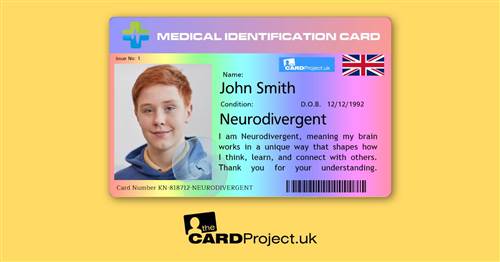
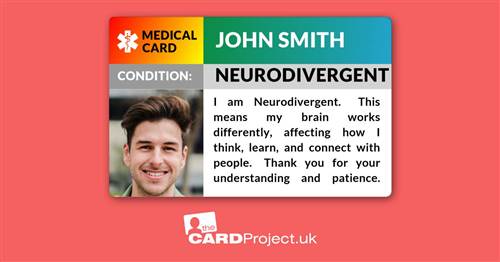
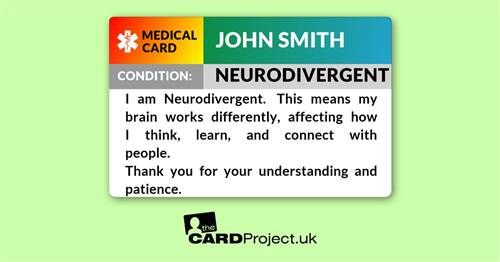
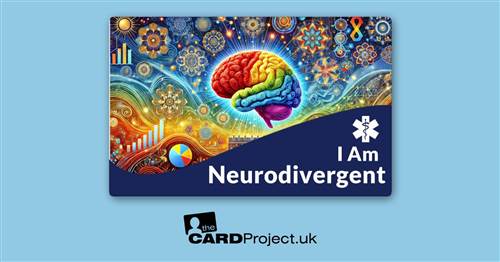
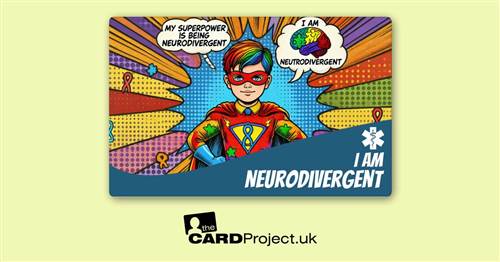
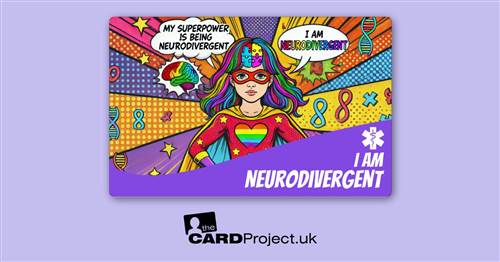
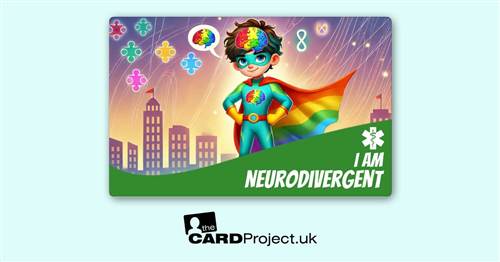
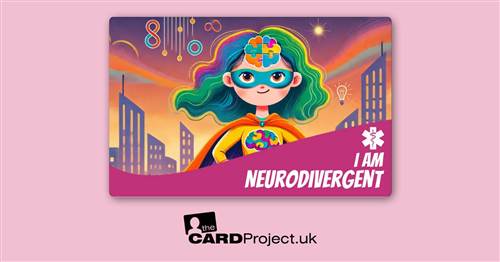
A Neurodivergent Medical Card provides a simple but effective way to communicate essential information when it matters most. It acts as a quick and reliable way to let others know that you may need extra time, patience, or adjustments.
Why it helps you stay safe
-
In Medical or Emergency Situations: If you find it difficult to explain symptoms or cope with the sensory overload of a hospital, your card provides essential info to first responders instantly.
-
In Public Spaces: Shopping centres and airports can trigger sensory overload. Showing your card to staff helps explain why you need a quieter space or an alternative way of receiving info.
-
At Work or in Education: A card is a discreet way to inform employers or teachers about your needs. It supports your right to reasonable adjustments under the Equality Act 2010 without having to repeatedly explain yourself.
-
Reducing Anxiety and "Masking": Masking—trying to blend in to avoid negative reactions—is exhausting and leads to burnout. A medical card allows you to be open about your needs in a simple and stress-free way.
Peace of Mind for Parents and Caregivers
For parents of neurodivergent children, a medical card is vital. It ensures that teachers, support staff, or members of the public are aware of a child’s needs, even if the parent is not present. This is especially useful in situations where a child becomes overwhelmed or struggles with communication.
Choosing the Right Card: From Awareness to Personalised IDs
There is no one-size-fits-all approach to neurodivergence, which is why we provide options designed to suit different needs.
Simple Awareness Cards: These provide general information about being neurodivergent, perfect for raising awareness and asking for patience in public.
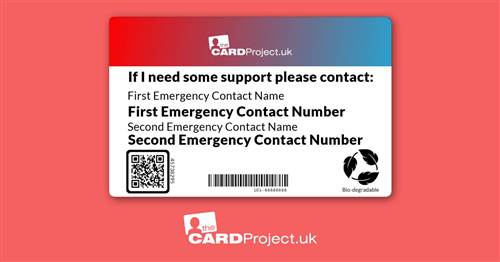
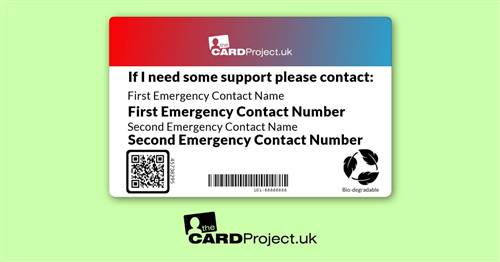
Personalised Medical IDs: These are designed for those who need to carry specific, life-saving information. They include space for emergency contacts, specific communication tips, and medication alerts.
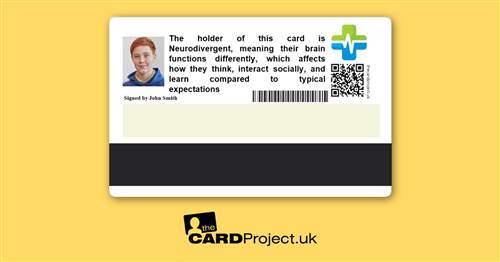
Photo ID Cards: We offer cards that include your photograph for instant identification, which is highly recommended for security settings or emergency triage.
Our 2026 Medical ID Standards
We provide physical, high-quality cards designed for durability and clarity. These are tools built for the real world.
-
High-Quality PVC Material: Our cards are made from durable PVC, built to withstand daily use without fading or breaking.
-
Standard Wallet Size: Every card is credit-card sized, fitting perfectly into any standard wallet or cardholder for immediate access.
-
High-Contrast, Professional Print: We use clear, bold text to ensure that first responders and staff can read your vital information even in low light or high-pressure situations.
-
Personalised Safety Details: We offer options that include your photograph for instant identification, as well as space for multiple emergency contacts and specific communication tips.
Your questions answered: 2026 Neurodivergence FAQ
Q: Do I need a doctor's letter to get a card?
No. With a potential 6-year wait list for assessments documented in FOI requests, we believe you shouldn't be left unsafe. Our cards allow you to disclose your neurodivergence and provide emergency contacts today, regardless of where you are in the diagnostic process.
Q: Why should I tell my doctor about "medicines doing the opposite"?
Because as medical studies in anaesthesia show, you don't want a "calming" medicine to trigger a panic reaction. Carrying your card identifies you as neurodivergent, which prompts medical staff to follow the correct safety protocols and check for potential medication sensitivities before any procedure.
Q: Is a general awareness card enough?
It depends on your needs. A Photo ID provides more authority in high-pressure situations, such as with police or medical staff. It confirms exactly who the card belongs to, ensuring that emergency contacts and condition information are linked to the correct person.
Q: How does this help in schools or workplaces?
It provides a discreet way to inform others about your needs. It can assist in accessing reasonable adjustments under the Equality Act 2010 without having to repeatedly explain your history.
Q: Why is a physical card better than a phone app? In an emergency, first responders don't have time to unlock your phone or wait for a QR code to load. A physical card is visible and accessible in seconds.
A simple guide for your caregivers and first responders
If you are helping a neurodivergent person, following these steps ensures their safety and reduces distress:
-
Wait: Give at least 10 seconds for the person to process what you’ve said. Do not repeat the instruction immediately; give their brain time to catch up.
-
Reduce Input: Sensory overload can lead to shut-downs. Turn off sirens, dim the lights, or move the person to a quiet corner where they can feel safe.
-
Be Literal: Avoid sarcasm, metaphors, or complex instructions. Say exactly what needs to happen in short, clear, one-at-a-time steps.
-
Check for an ID: Look for a physical card in their wallet or on a lanyard. This identifies them as neurodivergent and provides their Emergency Contact. Call this contact immediately, as they will know the person's specific needs and medical history.
-
Follow Neuro-Affirming Protocols: Respect the individual's autonomy. Use the presence of the card as a prompt to follow the communication and safety tips listed above, even if the person cannot currently speak for themselves.
Taking the Next Step Toward Safety and Confidence
Living as a neurodivergent person in a world that wasn't built for you is a daily act of courage. Whether you are navigating a 6-year wait for a diagnosis or supporting a child who experiences the world with intense sensitivity, you deserve to feel safe and seen.
A Medical ID card is a small, practical tool, but the peace of mind it provides is significant. It’s about taking the burden of explanation off your shoulders and ensuring that in a moment of crisis, your needs are respected. You don't have to wait for the system to change to start advocating for yourself today.
Stay safe, stay curious about your unique brain, and remember that you are your own best advocate.
Sources and Fact-Checking
-
The National Autistic Society: Employment statistics and workplace prevalence data.
-
Pro Bono Economics And Autistica: Economic modeling of the "cost of inaction" and potential UK productivity gains.
-
The Ehlers-Danlos Society: Clinical research on the link between hEDS/HSD and neurodivergent populations (specifically ADHD and Autism).
-
British Journal of Anaesthesia: Clinical documentation regarding paradoxical reactions to benzodiazepines and pediatric sedation guidelines.
-
Freedom of Information (FOI) Data: Regional NHS wait times and assessment backlog statistics.
-
NHS Integrated Care Board (ICB) Financial Reports: Data on private sector spending for neurodevelopmental assessments.
-
World Health Organization (WHO): International Classification of Diseases 11th Revision (ICD-11) criteria.
-
American Psychiatric Association: Diagnostic and Statistical Manual of Mental Disorders (DSM-5-TR) updates.
Information Guides
Understanding neurodivergence is a journey, and we want to make sure you have the right support every step of the way. We’ve written a series of detailed information guides to help you dive deeper into specific topics, find practical advice, and gain a clearer understanding of how different brains navigate the world.
What You Need To Know About Being Neurodivergent - For anyone exploring neurodivergence for the first time, this indepth guide covers how a diagnosis works, the common struggles you'll face, and why your different perspective is a strength—not a flaw.
Brain Diversity: Why No Two Minds Are the Same (A Guide to Neurodivergence) - Introducing the "Neurodiversity Paradigm." Instead of looking at conditions as "broken" parts of a brain, we explain how human brains naturally come in different "operating systems." Our guide helps family members move away from the idea of "fixing" someone and toward supporting their unique way of thinking.
The Body-Brain Connection: A Guide to the Neurodivergent "Trifecta" (hEDS, POTS, and MCAS) - This guide explains the frequently seen link between neurodivergence, stretchy joints (hEDS), dizzy spells (POTS), and allergies (MCAS). It helps families understand that physical symptoms like fainting or stomach issues are often directly tied to how a neurodivergent person's body is built.
The Brain’s CEO: A Guide to Executive Function and Neurodivergence: If you've ever wondered why a brilliant person can struggle with simple daily tasks, discover how the "Brain's CEO" handles things differently in neurodivergence. It explains how the brain’s "manager" struggles with starting tasks, keeping track of time, and managing emotions, offering "body-doubling" and environment-hacking tips for daily life.
Expect the Unexpected: When Medicine Works Differently for Neurodivergent Brains - If "standard" medications or doses don't seem to work for you, discover the biological reasons why neurodivergent bodies often react in unexpected ways.
Fight, Flight, or Hide: A Neurodivergent Guide to Staying Safe in a Crisis - If you've wondered why a loved one shuts down or hides when things get stressful, discover how to build an emergency plan that works for a neurodivergent brain.
When the World is Too Loud: Understanding Neurodivergent Meltdowns and Shutdowns - When the world gets too loud, a neurodivergent brain can react with an explosion or an implosion—discover how to spot the difference and offer the right support.
The Two-Way Street: Understanding Communication Gaps in Neurodivergence - If you've ever felt like you and your loved one are speaking entirely different languages, discover how to bridge the gap between neurotypical and neurodivergent communication styles.
The Spiky Profile: Why Neurodivergent Skills Aren't Always Level - If you've ever felt frustrated by a loved one who excels at complex tasks but struggles with daily basics, discover why a "spiky profile" is a natural biological reality.